Biosignatures
This project explores dance improvisation as a transformative and evolving practice, through the embodiment of BioGeometry Signatures developed by Dr. Ibrahim Karim over more than fifty years of research.
This project explores dance improvisation as a transformative and evolving practice, through the embodiment of BioGeometry Signatures developed by Dr. Ibrahim Karim over more than fifty years of research.
BioSignatures are geometric forms composed of a continuous linear trace, drawn in a single gesture. They are conceived to reproduce certain patterns of circulation within the body — internal flows associated with the functioning of organs.
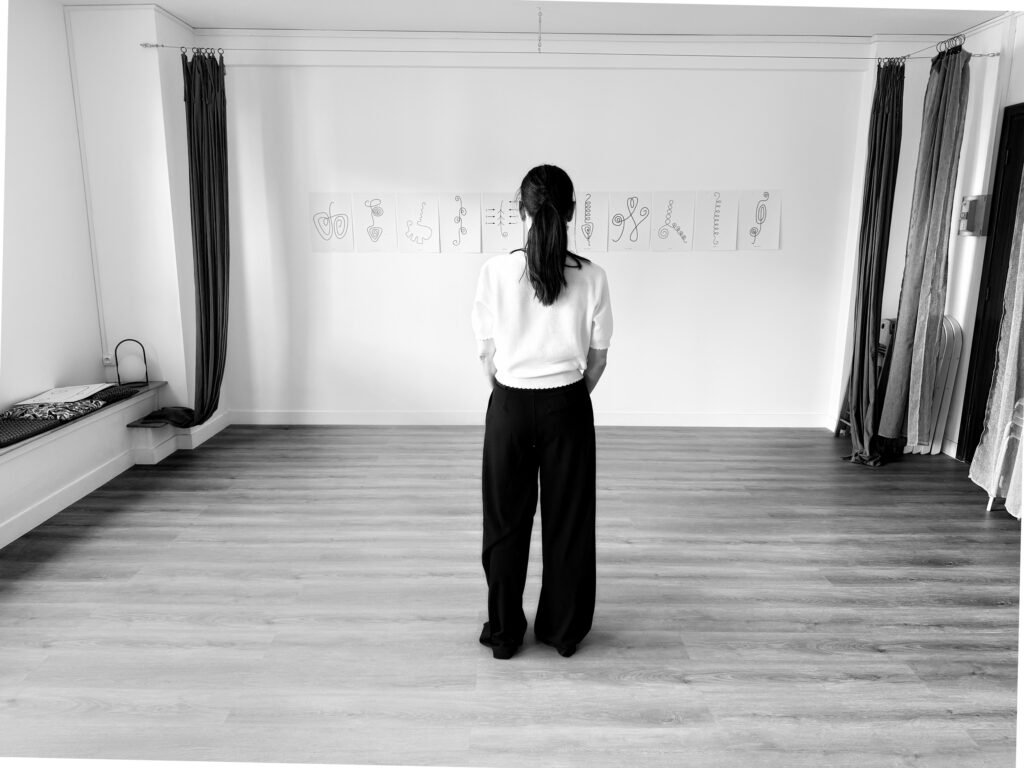
These forms are not understood as symbols, but as active structures. They are designed to resonate with internal patterns and to influence the quality of their functioning. According to BioGeometry, when a form accurately reflects a pattern of internal circulation, it can act as a structural model: through similarity of form, it can stimulate or reorganize the corresponding flow within the body.
At the foundation of this approach lies a key idea: the body is not a closed system. BioGeometry understands it as an open organism, in continuous exchange with the surrounding space.
This perspective resonates deeply with improvisation. In dance improvisation, movement is never isolated; it emerges from an ongoing dialogue with gravity, spatial directions, and the tensions of the environment. The body does not act within space as if it were a neutral container — it co-constructs it, transforms it, and is transformed by it. Body and space form an interdependent field.
It is precisely at this point of convergence that my research is situated.
“What happens when a BioSignature is no longer observed or applied externally, but experienced from within?”
The project is guided by a central question: what happens when a BioSignature is no longer observed or applied externally, but experienced from within? What does it become when the body itself becomes the site of the signature?
If a line can influence an organ through resonance, what occurs when the organism as a whole begins to organize itself along that line? When movement engages the breath, the spinal axis, muscular tone, and spatial orientation?
Rather than reproducing these diagrams graphically, I choose to engage them physically. Improvisation becomes the field of this exploration. The aim is not to apply a form to the body, but to investigate how the embodiment of certain formal structures may support processes of regulation.
The continuity of a gesture may stabilize the breath. A clear direction may reinforce grounding. A coherent spatial organization may affect both muscular tone and emotional state.
The work is structured through the reading of BioSignatures, used as a dispositif — an operative framework that orients improvisation without fixing it, allowing the exploration of how embodied forms simultaneously transform the perception of space and the internal organization of the body.