Embodied workshops
for organizations.
Supporting teams in navigating complexity, where decisions and new possibilities can emerge.
Organizations today operate in complex and uncertain environments, where situations are continuously evolving and cannot be fully anticipated. In these contexts, the challenge is not only what to do, but how to act while situations are still unfolding.
As more processes become mediated by digital systems and artificial intelligence, the role of the body becomes even more critical. Perception, decision, and action cannot be outsourced — they remain grounded in lived, embodied experience.
Action does not happen in abstraction.
It takes place through the body, in relation to others, and within dynamic environments.
I design and facilitate workshops that work at this level.
Participants engage in structured real-time situations where they must act, decide, and relate without predefined solutions. Each situation introduces evolving conditions — something is at stake, constraints may be present, and outcomes are not known in advance.
This is not about discussing action.
It is about experiencing how action actually happens under real conditions.
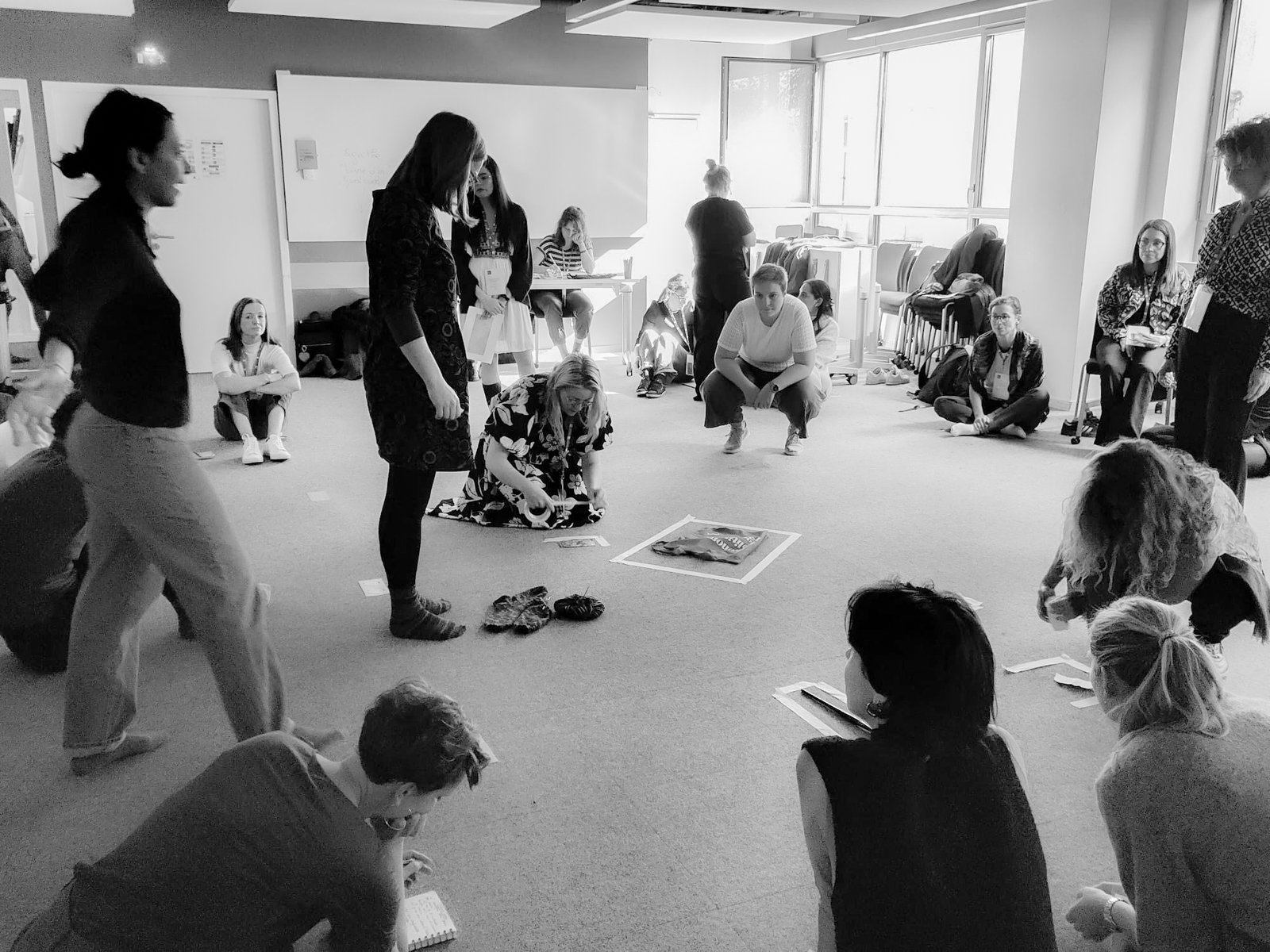
The work unfolds through a series of structured, real-time situations in which participants are invited to act, decide, and interact without a predefined path. Each situation introduces evolving conditions — something is at stake, constraints or roles may be present, and outcomes are not known in advance.
Participants engage directly through the body — through movement, stillness, posture, and spatial positioning. They begin to notice how they orient themselves, when they move forward or hold back, and how these physical responses shape their actions and decisions.
At the same time, the work develops relational precision. Participants become attentive to how interaction unfolds — how they position themselves in relation to others, how they respond, and how coordination emerges through continuous adjustment. Action is not individual; it is co-created moment by moment.
As the situations evolve, participants begin to recognize how they actually respond under pressure — how they anticipate, control, hesitate, or commit. What is usually implicit becomes visible and tangible through direct experience.
From there, a shift takes place: actions become more precise, decisions more grounded, and interactions more responsive to what is actually happening.
At a time when many processes are increasingly mediated by digital systems and artificial intelligence, the role of the body becomes even more critical.
Key Skills I Help Organizations Develop and Embody
Participants and teams develop a more precise and adaptable way of acting — able to engage with complexity and make decisions as situations unfold. This includes the capacity to:
In practice, teams develop the ability to:
- Navigate complexity without relying on predefined solutions
- Remain fully engaged in ambiguous and evolving contexts
- Respond with accuracy and intention rather than reacting automatically
- Build clear, attentive, and effective relationships
- Stay oriented and make sense of shifting conditions
- Trust and integrate intuition into decision-making, grounded in embodied awareness
- Co-create dynamically — acting, adjusting, and building together in real time
Improvisation is not used as performance, but as a way of engaging with situations where the future is not given. It allows participants to experience how action, decision, and relation take shape in context, while supporting the emergence of a more attentive and responsive way of acting, without relying on predefined answers.
Workshops are shaped in relation to each context, from short interventions to longer processes.