Dance
improvisation.
Dance improvisation is a practice that develops the capacity to act in uncertainty, to make decisions without knowing in advance, and to allow new possibilities to emerge in real time.
Dance improvisation is the practice of entering movement without a predetermined outcome, without choreography to execute or form to reproduce. The body enters space and begins to perceive — gravity, breath, the textures of the floor, light, sound, the presence of others — and it is from this listening that movement emerges.
This is not an absence of structure, but a sensitive organization that takes shape in the moment. Form is not decided in advance; it emerges through attention, relation, and the continuous adjustment between perception and action. Composition does not precede experience — it unfolds through it.
Learning dance improvisation is also learning to trust. No model is given, only points of reference, situations, and supports from which each person is invited to engage with the moment, to listen to their physical responses, and to meet what appears. Gradually, a capacity develops — to act without anticipating, to decide in the moment — allowing an intuitive and direct form of intelligence to emerge from experience.
Within this process, the body perceives, acts, and decides continuously. Weight shifts, attention moves, contact transforms direction, imbalance opens new possibilities. Choices do not come from external control, but emerge from sensation itself.
To improvise is to create the conditions for emergence — to allow something to appear that could not have been planned.
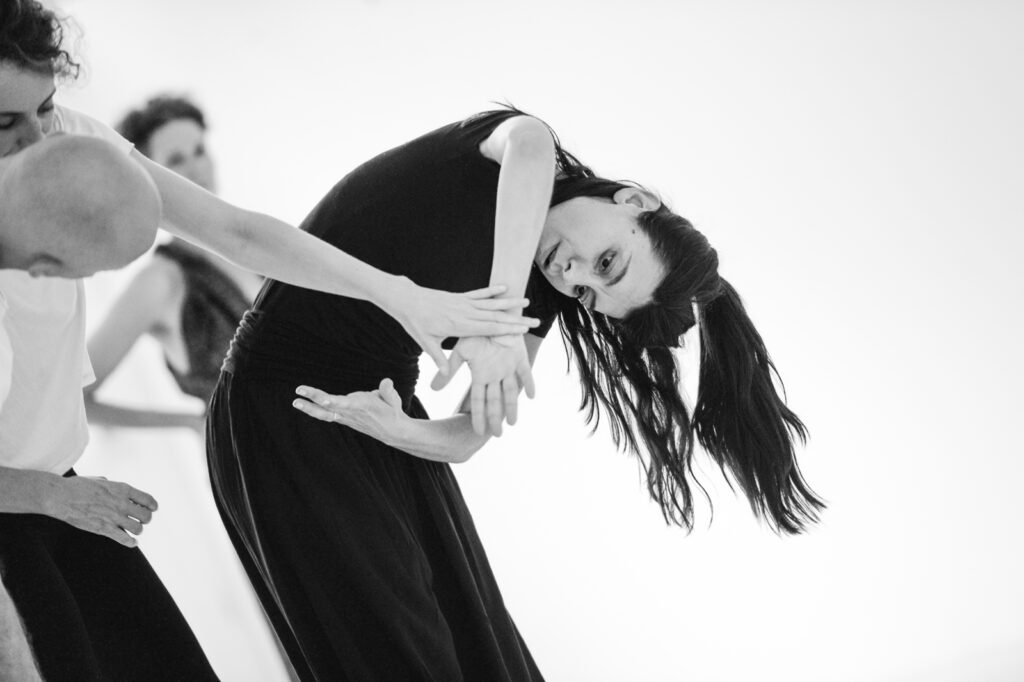
Over time, the practice makes visible our habitual ways of acting: anticipating, controlling, holding back. As these patterns are recognized, other possibilities become available, and something can begin to shift.
This work requires a framework that is both open and supportive, allowing each person to engage, to take the risk of exploring, and to express themselves with authenticity. Gradually, judgment loosens, and the space becomes one of inquiry, play, and shared experience.
Dance improvisation thus becomes an evolving practice — one that develops the capacity to engage with the unexpected, to remain in relation to what emerges, and to act within uncertainty. Over time, it transforms the way we are in the world, cultivating a more attentive and flexible presence, capable of staying in contact with what is.